

How To Draw Lewis Structures Khan Academy
Introduction to Lewis Structures
The only thing smaller than atoms are their subatomic particles; electrons, protons, and neutrons. Not even under a complex microscopic can we view the individual electrons that surround an atom'south nuclei. The Lewis Dot Structure is a visual which represents the outermost shell of electrons, also known as valence electrons, and possible covalent bonds within an atom or molecule. These valence electrons are negatively charged and are attracted to the positively charged nucleus, made up of neutrons and protons. Keep in mind that in reality electrons are constantly moving around the nucleus and are non rooted in one place as portrayed in a 2d construction.
A Lewis Dot Structure is drawn by a serial of dots, lines, and diminutive symbols and provides a structure for the way that the cantlet or molecule is arranged. A Lewis Dot Construction can be made for a single atom, a covalent chemical compound, or a polyatomic ion.
Using the Periodic Tabular array to Draw Lewis Dot Structures
The periodic table has all of the information needed to draw a Lewis dot construction. Each Group, or column, is indicated by a roman numeral which represents the number of valence electrons. This is applicable to the entire group. For example, all elements which fall within the first column, or Group I, has one (1) valence electron. All elements in Group II have two (2) valence electrons, all the way upward to VIII, eight (eight) valence electrons. Properties are also consistent beyond the rows, or periods, of the periodic table. Periods are indicated by a number, 1, 2, three, etc. which represent the energy level, or beat out of electrons. The first flow, or row, has only ane energy level that can hold a total of two electrons. Menses ii, with a second shell, tin agree a total of eight (8) electrons, too known as the octet dominion. Period 3 and and then along can hold more than than eight (8) electrons.
The periodic tabular array also conveys electronegativity. The nearly electronegative elements are located in the uppermost right corner of the period table and subtract in electronegativity as you go down the Grouping or more left of a Menstruation.
Throughout drawing Lewis dot structures, the periodic table volition be a strong reference indicate when working with electrons, covalent bonding, and polyatomic ions.
Using Lewis Dot Structures to Show Valence Electrons
Lewis dot structures can be drawn to show the valence electrons that surround an atom itself. This blazon of Lewis dot structure is represented by an atomic symbol and a series of dots. Meet the following examples for how to describe Lewis dot structures for common atoms involved in covalent bonding.
Example 1. Depict the Lewis Dot Structure for the Hydrogen atom.
Since Hydrogen is in Group I it has one (1) valence electron in its beat out.

Example 2. Draw the Lewis Dot Structure for the Florine atom.
Since Fluorine is in Flow 2, it tin fit a maximum of eight (8) electrons second energy level. Fluorine Grouping VII, which ways information technology has a full of vii (7) valence electrons around the atom.

Example 3. Draw the Lewis Dot Structure for Oxygen.
Since Oxygen is in Period two, it tin can fit a maximum of eight (eight) electrons second free energy level. Oxygen Grouping Six, which ways it has a total of six (6) valence electrons around the atom

Instance A. Decide the total number of valence electrons for C
- Carbon is in Group Four, 4 valence electrons
- Total # of Valence Electrons in Carbon = 4
Example B. Determine the total number of valence electrons for HiiO
- Hydrogen, Grouping I, has 1 electron x two = 2
- Oxygen, Group Six, has 6 electrons x one = vi
- Full Valence Electrons in h2o = 8
Example C. Determine the full number of valence electrons for MgBrii
- Magnesium, Group two, has 2 electrons ten one = 2
- Bromine, Group 7, has 7 electrons x 2 = xiv
- Total # of Valence Electrons in MgBr2 = 16
How to Draw a Lewis Dot Structure
Step 1. Make up one's mind the total number of valence electrons to be depicted in the Lewis diagram.
Example: CO2 Total = xvi

Step 2. Identify least electronegative element in center and draw single bonds from the primal atom to other atoms.

Step 3. Determine how many electrons must exist added to central element.
Assume that each outer element has a full valence (two for H, viii for everything else) from bonding and non-bonding electrons. Total all of these electrons, and subtract that from the total number of valence electrons in the molecule. CO2 has 16 valence electrons. Nosotros assume each O has 8 valence electrons. ii×viii=16; 16-sixteen=0 therefore we don't need to add any electrons to C
Step 4. Add double or triple bonds to cardinal atom until it has a total octet
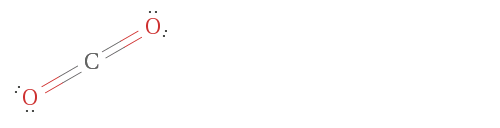
Step 5. Add electrons to outer elements until they accept total octets
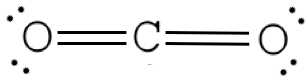
Examples for Drawing Lewis Dot Structure for Covalent Bonds
Here, nosotros will exist using the determined full number of valence electrons per atom and drawing them in the proper places. Reference the "How to Describe a Lewis Dot Construction" for a Stride by Footstep guide. Run into the following Lewis dot construction diagrams for a few covalent compounds.
Example 1. Ammonia, NH3
Nitrogen is in Group V which means it has a total of five (5) valence electrons. There are three (3) hydrogens present, each with their ain sole electron giving the entire molecule a total of eight (8) to be accounted for. Since Nitrogen has 5 electrons and is looking for a total of viii to fulfill its second free energy beat out, it is satisfied by the presence of 3 hydrogens which fulfills the octet rule. A nonbonding pair of Nitrogen is left and represented a pair of two dots.
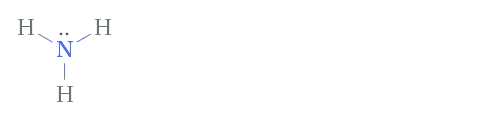
Example 2. Methane, CH4
In this construction, there are no nonbonding pairs of electrons nowadays. All have been properly bonded in a series of lines representing two electrons each. In methane, each Hydrogen has the first free energy beat filled with 2 electrons, its own valence electron along with a shared electron from Carbon, and Carbon'south second energy vanquish is filled with a total of eight electrons, 4 of its own and 4 shared (i from each Hydrogen surrounding it).
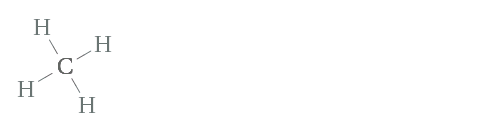
Cartoon Lewis Dot Structures for Polyatomic Ions
Lewis Dot Structures for cartoon polyatomic ions are washed very similarly to that of drawing individual atoms or covalent compounds. Still, in this instance, we volition be dealing with ions rather than simple atoms. Ions are going to possess either a positive or negative charge which should be reflected by the number of electrons drawn every bit well equally an indication of a "-"or "+". This ways that at that place are either additional electrons present to create a negative charge or less electrons present to create a more positive charge.
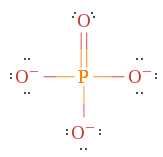
Example 1. PO4 3-, Phosphate ion
With 4 oxygens present with half dozen (half-dozen) electrons each and a phosphorus with five (v) there should exist a total of 31 electrons. Still, since there is a charge of -iii.
There are a few things to keep in mind. Phosphorus is in Period 3, which ways it can hold more than 8 electrons and creates a double bond to the oxygen which fulfills the octet rule for ane oxygen, but not the others.
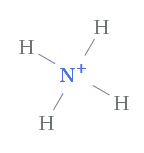
Case 2. NH4 + , Ammonium ion
With ammonium, we are dealing with a positively charged polyatomic ion. The total valence electrons of the nitrogen and four hydrogens is 9 electrons. Since there is a positive charge of 1+ that ways there is one less electron, and so there will be a total of eight, which are represented by the iv bonds as lines.
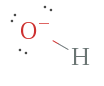
Instance three. OH–, Hydroxide ion
The hydroxide ion has a full of how many electrons? Well, oxygen has 6 and hydrogen has 1, but since in that location is a negative charge on the ion, it will have an additional ion making a total 8 electrons, which are representing by the bonding pair between oxygen and hydrogen along with the iii nonbonding (lone) pairs surrounding oxygen.
Key Concepts:
Decide the full number of valence electrons of the element or chemical compound. If a molecule has more one element, add the valence electron of all elements present in the compound.
Decide which atom volition be the fundamental atom of the Lewis Dot Construction. The primal atom is the to the lowest degree most electronegative atom in the chemical compound. Call up the trend for electronegativity on the periodic table. Once adamant, draw that chemical element by atomic symbol in the center and draw unmarried bonds to the other atoms.
Decrease full shell of valence electrons (2 for H, 8 for everything else) of each outer atom from the total number of valence electrons associated with the molecule. Distribute the remaining electrons to the fundamental atom as not-bonding pairs
Course double and triple bonds until the fundamental cantlet has a full octet.
Draw nonbonding pairs around the outer atoms until they have a full octet.
Cheque your piece of work: Ensure that all of your valence electrons and bonds are accounted for.
Practice with Drawing Lewis Dot Structures
- Carbon
- Sodium
- Neon
- HCl
- H2O
- SO2
- NO3 –
- ClO3 –
- CN–
- And so4 2-
Looking for Chemistry practice?
Check out our other manufactures on Chemistry.
You tin also find thousands of do questions on Albert.io. Albert.io lets you lot customize your learning experience to target exercise where you need the well-nigh help. We'll give you challenging practice questions to help you achieve mastery in Chemistry.
Get-go practicing here .
Are yous a teacher or administrator interested in boosting Chemistry educatee outcomes?
Learn more about our schoolhouse licenses here.

Source: https://www.albert.io/blog/how-to-draw-lewis-structures/
Posted by: mcnabbshor1952.blogspot.com
0 Response to "How To Draw Lewis Structures Khan Academy"
Post a Comment