

What Is The Political Makeup Of The Senate

Control of the Congress from 1855 to 2021
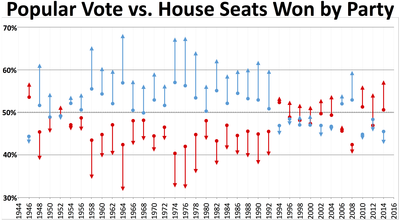
Pop vote and house seats won past party
Party divisions of Us Congresses have played a central part on the organization and operations of both chambers of the United States Congress—the Senate and the House of Representatives—since its establishment as the bicameral legislature of the Federal government of the United States in 1789. Political parties had non been anticipated when the U.Southward. Constitution was drafted in 1787, nor did they exist at the fourth dimension the beginning Senate elections and Firm elections occurred in 1788 and 1789. Organized political parties adult in the U.S. in the 1790s, but political factions—from which organized parties evolved—began to appear most immediately after the 1st Congress convened. Those who supported the Washington administration were referred to as "pro-administration" and would eventually form the Federalist Party, while those in opposition joined the emerging Democratic-Republican Political party.[1]
Political party divisions by Congress [edit]
The following table lists the party divisions for each United States Congress. Note that numbers in boldface denote the majority party at that particular time while italicized numbers signify a Congress in which the majority party inverse intra-term.
| Congress | Years | Senate | House of Representatives | President | Trifecta | |||||||||
|---|---|---|---|---|---|---|---|---|---|---|---|---|---|---|
| Total | Anti- Admin[2] | Pro- Admin[3] | Others | Vacancies | Total | Anti- Admin | Pro- Admin | Others | Vacancies | |||||
| 1st | 1789–1791 | 26 | 8 | 18 | — | — | 65 | 28 | 37 | — | — | George Washington | Yes[4] | |
| 2nd | 1791–1793 | 30 | 13 | 16 | — | 1 | 69 | 30 | 39 | — | — | Yes[four] | ||
| 3rd | 1793–1795 | 30 | 14 | 16 | — | — | 105 | 54 | 51 | — | — | No | ||
| Congress | Years | Total | Democratic- Republicans | Federalists | Others | Vacancies | Full | Autonomous- Republicans | Federalists | Others | Vacancies | President | Trifecta | |
| 4th | 1795–1797 | 32 | eleven | 21 | — | — | 106 | 59 | 47 | — | — | George Washington[v] | No | |
| 5th | 1797–1799 | 32 | 10 | 22 | — | — | 106 | 49 | 57 | — | — | John Adams | Aye | |
| 6th | 1799–1801 | 32 | 10 | 22 | — | — | 106 | 46 | 60 | — | — | Yes | ||
| 7th | 1801–1803 | 34 | 17 | 15 | — | 2 | 107 | 68 | 38 | — | ane | Thomas Jefferson | Yes | |
| 8th | 1803–1805 | 34 | 25 | ix | — | — | 142 | 103 | 39 | — | — | Yes | ||
| ninth | 1805–1807 | 34 | 27 | 7 | — | — | 142 | 114 | 28 | — | — | Yes | ||
| 10th | 1807–1809 | 34 | 28 | half dozen | — | — | 142 | 116 | 26 | — | — | Yeah | ||
| 11th | 1809–1811 | 34 | 27 | 7 | — | — | 142 | 92 | 50 | — | — | James Madison | Yes | |
| twelfth | 1811–1813 | 36 | 30 | half dozen | — | — | 143 | 107 | 36 | — | — | Yes | ||
| 13th | 1813–1815 | 36 | 28 | viii | — | — | 182 | 114 | 68 | — | — | Yes | ||
| 14th | 1815–1817 | 38 | 26 | 12 | — | — | 183 | 119 | 64 | — | — | Yep | ||
| 15th | 1817–1819 | 42 | 30 | 12 | — | — | 185 | 146 | 39 | — | — | James Monroe | Yep | |
| 16th | 1819–1821 | 46 | 37 | 9 | — | — | 186 | 160 | 26 | — | — | Aye | ||
| 17th | 1821–1823 | 48 | 44 | iv | — | — | 187 | 155 | 32 | — | — | Yes | ||
| 18th | 1823–1825 | 48 | 43 | 5 | — | — | 213 | 189 | 24 | — | — | Yes | ||
| Congress | Years | Total | Jacksonian[6] | Anti-Jackson[half dozen] | Others | Vacancies | Total | Jacksonian[6] | Anti-Jackson[6] | Others | Vacancies | President | Trifecta | |
| 19th | 1825–1827 | 48 | 26 | 22 | — | — | 213 | 104 | 109 | — | — | John Quincy Adams[7] | No | |
| 20th | 1827–1829 | 48 | 27 | 21 | — | — | 213 | 113 | 100 | — | — | No | ||
| 21st | 1829–1831 | 48 | 25 | 23 | — | — | 213 | 136 | 72 | 5 | — | Andrew Jackson | Yes | |
| 22nd | 1831–1833 | 48 | 24 | 22 | two | — | 213 | 126 | 66 | 21 | — | Yep | ||
| 23rd | 1833–1835 | 48 | xx | 26 | 2 | — | 240 | 143 | 63 | 34 | — | No | ||
| 24th | 1835–1837 | 52 | 26 | 24 | two | — | 242 | 143 | 75 | 24 | — | Yes | ||
| Congress | Years | Full | Democrats | Whigs | Others | Vacancies | Total | Democrats | Whigs | Others | Vacancies | President | Trifecta | |
| 25th | 1837–1839 | 52 | 35 | 17 | — | — | 242 | 128 | 100 | 14 | — | Martin Van Buren | Aye | |
| 26th | 1839–1841 | 52 | 30 | 22 | — | — | 242 | 125 | 109 | 8 | — | Yeah | ||
| 27th | 1841–1843 | 52 | 22 | 29 | — | 1 | 242 | 98 | 142 | 2 | — | John Tyler[8] | Yes/No[9] | |
| 28th | 1843–1845 | 52 | 23 | 29 | — | — | 223 | 147 | 72 | 4 | — | No | ||
| 29th | 1845–1847 | 58 | 34 | 22 | — | two | 228 | 142 | 79 | 7 | — | James Thousand. Polk | Aye | |
| 30th | 1847–1849 | 60 | 38 | 21 | 1 | — | 230 | 110 | 116 | iv | — | No | ||
| 31st | 1849–1851 | 62 | 35 | 25 | two | — | 233 | 113 | 108 | 11 | 1 | Zachary Taylor[10] | No | |
| 32nd | 1851–1853 | 62 | 36 | 23 | three | — | 233 | 127 | 85 | 21 | — | Millard Fillmore | No | |
| 33rd | 1853–1855 | 62 | 38 | 22 | two | — | 234 | 157 | 71 | 6 | — | Franklin Pierce | Yeah | |
| Congress | Years | Total | Democrats | Opposition[11] | Others | Vacancies | Total | Democrats | Opposition | Others | Vacancies | President | Trifecta | |
| 34th | 1855–1857 | 62 | 39 | 21 | 2 | — | 234 | 83 | 100 | 51 | — | Franklin Pierce | No | |
| Congress | Years | Total | Democrats | Republicans | Others | Vacancies | Total | Democrats | Republicans | Others | Vacancies | President | Trifecta | |
| 35th | 1857–1859 | 64 | 39 | 20 | 5 | — | 237 | 131 | 94 | thirteen | — | James Buchanan | Yeah | |
| 36th | 1859–1861 | 66 | 38 | 26 | two | — | 237 | 101 | 113 | 23 | — | No | ||
| 37th | 1861–1863 | 50 | 11 | 31 | 7 | 1 | 178 | 42 | 106 | 28 | 2 | Abraham Lincoln[12] | Yes | |
| 38th | 1863–1865 | 51 | 12 | 29 | — | — | 183 | eighty | 103 | — | — | Yeah | ||
| 39th | 1865–1867 | 52 | 10 | 42 | — | — | 191 | 46 | 145 | — | — | Andrew Johnson[13] | Yes/No[fourteen] | |
| 40th | 1867–1869 | 53 | 11 | 42 | — | — | 193 | 49 | 143 | — | ane | No | ||
| 41st | 1869–1871 | 74 | 11 | 61 | — | 2 | 243 | 73 | 170 | — | — | Ulysses Due south. Grant | Aye | |
| 42nd | 1871–1873 | 74 | 17 | 57 | — | — | 243 | 104 | 136 | 3 | — | Yes | ||
| 43rd | 1873–1875 | 74 | 19 | 54 | — | 1 | 293 | 88 | 203 | — | 2 | Yes | ||
| 44th | 1875–1877 | 76 | 29 | 46 | — | 1 | 293 | 181 | 107 | 3 | 2 | No | ||
| 45th | 1877–1879 | 76 | 36 | 39 | i | — | 293 | 156 | 137 | — | — | Rutherford B. Hayes | No | |
| 46th | 1879–1881 | 76 | 43 | 33 | — | — | 293 | 150 | 128 | xiv | 1 | No | ||
| 47th | 1881–1883 | 76[15] | 37 | 37 | 2 | — | 293 | 130 | 152 | xi | — | Chester A. Arthur[16] | No | |
| 48th | 1883–1885 | 76 | 36 | 40 | — | — | 325 | 200 | 119 | 6 | — | No | ||
| 49th | 1885–1887 | 76 | 34 | 41 | — | one | 325 | 182 | 140 | two | 1 | Grover Cleveland | No | |
| 50th | 1887–1889 | 76 | 37 | 39 | — | — | 325 | 170 | 151 | 4 | — | No | ||
| 51st | 1889–1891 | 84 | 37 | 47 | — | — | 330 | 156 | 173 | one | — | Benjamin Harrison | Yes | |
| 52nd | 1891–1893 | 88 | 39 | 47 | 2 | — | 333 | 231 | 88 | 14 | — | No | ||
| 53rd | 1893–1895 | 88 | 44 | 38 | 3 | 3 | 356 | 220 | 126 | ten | — | Grover Cleveland | Aye | |
| 54th | 1895–1897 | 88 | 39 | 44 | 5 | — | 357 | 104 | 246 | seven | — | No | ||
| 55th | 1897–1899 | 90 | 34 | 46 | 10 | — | 357 | 134 | 206 | 16 | one | William McKinley[17] | Aye | |
| 56th | 1899–1901 | 90 | 26 | 53 | 11 | — | 357 | 163 | 185 | 9 | — | Yes | ||
| 57th | 1901–1903 | 90 | 29 | 56 | 3 | 2 | 357 | 153 | 198 | 5 | ane | Theodore Roosevelt | Yes | |
| 58th | 1903–1905 | 90 | 32 | 58 | — | — | 386 | 178 | 207 | — | 1 | Yes | ||
| 59th | 1905–1907 | 90 | 32 | 58 | — | — | 386 | 136 | 250 | — | — | Yes | ||
| 60th | 1907–1909 | 92 | 29 | 61 | — | two | 386 | 164 | 222 | — | — | Yeah | ||
| 61st | 1909–1911 | 92 | 32 | 59 | — | 1 | 391 | 172 | 219 | — | — | William H. Taft | Yes | |
| 62nd | 1911–1913 | 92 | 42 | 49 | — | 1 | 391 | 228 | 162 | 1 | — | No | ||
| 63rd | 1913–1915 | 96 | 51 | 44 | 1 | — | 435 | 290 | 127 | 18 | — | Woodrow Wilson | Yeah | |
| 64th | 1915–1917 | 96 | 56 | 39 | 1 | — | 435 | 231 | 193 | eight | three | Yes | ||
| 65th | 1917–1919 | 96 | 53 | 42 | 1 | — | 435 | 210 | 216 | 9 [eighteen] | — | Aye | ||
| 66th | 1919–1921 | 96 | 47 | 48 | 1 | — | 435 | 191 | 237 | 7 | — | No | ||
| 67th | 1921–1923 | 96 | 37 | 59 | — | — | 435 | 132 | 300 | 1 | 2 | Warren Yard. Harding[19] | Aye | |
| 68th | 1923–1925 | 96 | 43 | 51 | 2 | — | 435 | 207 | 225 | three | — | Calvin Coolidge | Yes | |
| 69th | 1925–1927 | 96 | 40 | 54 | 1 | ane | 435 | 183 | 247 | 5 | — | Yes | ||
| 70th | 1927–1929 | 96 | 47 | 48 | ane | — | 435 | 195 | 237 | three | — | Yes | ||
| 71st | 1929–1931 | 96 | 39 | 56 | ane | — | 435 | 163 | 267 | 1 | 4 | Herbert Hoover | Aye | |
| 72nd | 1931–1933 | 96 | 47 | 48 | 1 | — | 435 | 217 | 217 | i | — | No | ||
| 73rd | 1933–1935 | 96 | 59 | 36 | 1 | — | 435 | 313 | 117 | five | — | Franklin D. Roosevelt[20] | Yes | |
| 74th | 1935–1937 | 96 | 69 | 25 | ii | — | 435 | 322 | 103 | 10 | — | Yes | ||
| 75th | 1937–1939 | 96 | 76 | 16 | 4 | — | 435 | 333 | 89 | 13 | — | Yes | ||
| 76th | 1939–1941 | 96 | 69 | 23 | 4 | — | 435 | 261 | 169 | v | — | Yep | ||
| 77th | 1941–1943 | 96 | 66 | 28 | two | — | 435 | 268 | 162 | five | — | Yes | ||
| 78th | 1943–1945 | 96 | 57 | 38 | 1 | — | 435 | 222 | 209 | 4 | — | Yes | ||
| 79th | 1945–1947 | 96 | 57 | 38 | 1 | — | 435 | 243 | 190 | ii | — | Harry Southward. Truman | Yes | |
| 80th | 1947–1949 | 96 | 45 | 51 | — | — | 435 | 188 | 246 | 1 | — | No | ||
| 81st | 1949–1951 | 96 | 54 | 42 | — | — | 435 | 262 | 171 | 2 | — | Yes | ||
| 82nd | 1951–1953 | 96 | 48 | 47 | 1 | — | 435 | 235 | 199 | 1 | — | Yes | ||
| 83rd | 1953–1955 | 96 | 46 | 48 | 2 | — | 435 | 213 | 221 | 1 | — | Dwight D. Eisenhower | Yes[21] | |
| 84th | 1955–1957 | 96 | 48 | 47 | 1 | — | 435 | 232 | 203 | — | — | No | ||
| 85th | 1957–1959 | 96 | 49 | 47 | — | — | 435 | 234 | 201 | — | — | No | ||
| 86th | 1959–1961 | 98 | 64 | 34 | — | — | 437 | 284 | 153 | — | — | No | ||
| 87th | 1961–1963 | 100 | 64 | 36 | — | — | 437 | 262 | 175 | — | — | John F. Kennedy[22] | Yes[23] | |
| 88th | 1963–1965 | 100 | 67 | 33 | — | — | 435 | 258 | 176 | — | 1 | Lyndon B. Johnson | Yep | |
| 89th | 1965–1967 | 100 | 68 | 32 | — | — | 435 | 295 | 140 | — | — | Yes | ||
| 90th | 1967–1969 | 100 | 64 | 36 | — | — | 435 | 247 | 187 | — | 1 | Yep | ||
| 91st | 1969–1971 | 100 | 58 | 42 | — | — | 435 | 243 | 192 | — | — | Richard Nixon[24] | No[25] | |
| 92nd | 1971–1973 | 100 | 54 | 44 | 2 | — | 435 | 255 | 180 | — | — | No | ||
| 93rd | 1973–1975 | 100 | 56 | 42 | 2 | — | 435 | 243 | 192 | — | — | Gerald Ford | No | |
| 94th | 1975–1977 | 100 | 61 | 37 | ii | — | 435 | 291 | 144 | — | — | No | ||
| 95th | 1977–1979 | 100 | 61 | 38 | 1 | — | 435 | 292 | 143 | — | — | Jimmy Carter | Yeah[23] | |
| 96th | 1979–1981 | 100 | 58 | 41 | one | — | 435 | 277 | 157 | i[26] | — | Yes | ||
| 97th | 1981–1983 | 100 | 46 | 53 | 1 | — | 435 | 242 | 192 | 1[26] | — | Ronald Reagan | No | |
| 98th | 1983–1985 | 100 | 46 | 54 | — | — | 435 | 269 | 165 | 1[26] | — | No | ||
| 99th | 1985–1987 | 100 | 47 | 53 | — | — | 435 | 253 | 181 | 1[27] | — | No | ||
| 100th | 1987–1989 | 100 | 55 | 45 | — | — | 435 | 258 | 177 | — | — | No | ||
| 101st | 1989–1991 | 100 | 55 | 45 | — | — | 435 | 260 | 175 | — | — | George H. W. Bush | No | |
| 102nd | 1991–1993 | 100 | 56 | 44 | — | — | 435 | 267 | 167 | 1 | — | No | ||
| 103rd | 1993–1995 | 100 | 57 | 43 | — | — | 435 | 258 | 176 | one | — | Pecker Clinton | Yes[23] | |
| 104th | 1995–1997 | 100 | 47 | 53 | — | — | 435 | 204 | 230 | 1 | — | No | ||
| 105th | 1997–1999 | 100 | 45 | 55 | — | — | 435 | 206 | 227 | 2 | — | No | ||
| 106th | 1999–2001 | 100 | 45 | 55 | — | — | 435 | 211 | 223 | i | — | No | ||
| 107th | 2001–2003 | 100 | 50 [28] | 50/49[29] | 0/1 [thirty] | — | 435 | 212 | 221 | 2 | — | George W. Bush | Yep/No[31] | |
| 108th | 2003–2005 | 100 | 48 | 51 | ane[xxx] | — | 435 | 205 | 229 | 1 | — | Yes | ||
| 109th | 2005–2007 | 100 | 44 | 55 | 1[30] | — | 435 | 202 | 232 | one | — | Yes | ||
| 110th | 2007–2009 | 100 | 49 | 49 | 2 [32] | — | 435 | 233 | 202 | — | — | No | ||
| 111th | 2009–2011 | 100 | 56–58 [33] | xl–42[34] | 2 [32] | — | 435 | 257 | 178 | — | — | Barack Obama | Yes[23] | |
| 112th | 2011–2013 | 100 | 51 | 47 | two [35] | — | 435 | 193 | 242 | — | — | No | ||
| 113th | 2013–2015 | 100 | 53 | 45 | two [36] | — | 435 | 201 | 234 | — | — | No | ||
| 114th | 2015–2017 | 100 | 44 | 54 | 2[36] | — | 435 | 188 | 247 | — | — | No | ||
| 115th | 2017–2019 | 100 | 46/47 | 50-52 | 2[36] | — | 435 | 194 | 241 | — | — | Donald Trump | Yeah[21] | |
| 116th | 2019–2021 | 100 | 45/46 | 53/52 | 2[36] | — | 435 | 235 | 200 | — | — | No | ||
| 117th | 2021–2023 | 100 | 46–48 [37] | 51/fifty[38] | 2 [36] | — | 435 | 222 | 213 | — | — | Joe Biden | Yes[39] | |
| Congress | Years | Total | Democrats | Republicans | Others | Vacancies | Total | Democrats | Republicans | Others | Vacancies | President | Trifecta | |
| Senate | Business firm of Representatives | |||||||||||||
Partisan command of Congress [edit]
This table shows the number of Congresses in which a political party controlled either the House, the Senate, or the presidency.
| Party | Senate | House | Presidency | Trifecta |
|---|---|---|---|---|
| Democratic | 51 | 59 | 45 | xxx |
| Republican | 43 | 36 | 46 | 22[twoscore] |
| Democratic- Republican | 12 | 13 | 14 | 12 |
| Federalist | 3 | 2 | 2 | 2 |
| Pro- Assistants | 3 | ii | 0 | ii |
| Whig | 2 | two | ii | 0[41] |
| National Republican | 1 | 1 | 0 | 0 |
| Anti- Administration | 0 | one | 0 | 0 |
| Opposition | 0 | 1 | 0 | 0 |
| National Matrimony | 0 | 0 | 2 | 0 |
| Split control | 2[42] | 0 | i[43] | 49 |
| Independent | 0 | 0 | five | - |
See also [edit]
- Divided government in the United States
- Political party forcefulness in U.Due south. states
References [edit]
- ^ U.S. Senate: Party Divisions
- ^ The Anti-Administration Party was not a formal party but rather a faction opposed to the policies of Treasury Secretary Alexander Hamilton. The faction eventually coalesced into the Democratic-Republican Political party.
- ^ The Pro-Administration Political party was not a formal party but rather a faction supportive of the policies of Treasury Secretary Alexander Hamilton. The faction eventually coalesced into the Federalist Party.
- ^ a b Though Washington never formally joined a party, he was broadly sympathetic to the coalition which later became the Federalist Party.
- ^ Washington disapproved of formal political parties and refused to join either political party, though he became a symbol of the Federalist Party.
- ^ a b c d The Democratic-Republican Party bankrupt up into ii competing parties during the 1820s, but in that location is no official date of dissolution for the Democratic-Republicans. During the presidency of John Quincy Adams, Congress became divided betwixt a group that favored Adams and a group that favored Andrew Jackson. After Adams left office, Congress was divided into a grouping that supported the Jackson assistants and a group that opposed it. During Jackson'southward presidency, the pro-Jackson grouping coalesced into the Democratic Party, while the anti-Jackson grouping (which included the National Republican Party) joined with the Anti-Masonic Party and other groups to form the Whig Party.
- ^ Adams won election as a Democratic-Republican, simply he sought re-ballot as a National Republican.
- ^ Whig President William Henry Harrison died Apr 4, 1841, 1 month into his term, and was succeeded by John Tyler, who served for the rest of the term. Tyler had been elected as vice president on the Whig ticket, but he became an contained afterward the Whigs expelled him from the party on September 13, 1841.
- ^ Whigs held their only trifecta from March 4, 1841 until afterwards that twelvemonth when the Whigs expelled Tyler from the party on September 13 and he became an Contained.
- ^ President Taylor died July 9, 1850, virtually 1 year and four months into the term, and was succeeded past Millard Fillmore, who served for the remainder of the term.
- ^ The "Opposition Party" was the Congressional coalition formed by erstwhile Whigs and members of the nascent Republican Party. The Opposition Party opposed the Democratic Party in the aftermath of the collapse of the Whig Party.
- ^ President Lincoln was assassinated and died Apr fifteen, 1865, about a calendar month afterward kickoff his second term as president. He was succeeded by Democrat Andrew Johnson, who served the residual of the term.
- ^ Johnson was elected as vice president on the National Matrimony ticket, merely was a Democrat prior to the 1864 ballot.
- ^ Republicans had a trifecta until March four, 1865 when President Lincoln was inaugurated for his second term having run nether the National Union Party. Though he was not elected as a Republican, Lincoln practically enabled the Republican Party to take a trifecta until April 15, 1865 when he was assassinated. Once Lincoln's Vice President Andrew Johnson, who was a Democrat prior to the 1864 election, succeeded to the Presidency, Johnson broke the Republican Political party's practical trifecta
- ^ Neither party controlled the Senate in the 47th Congress in what's known equally the "Corking Senate Deadlock of 1881." "The Nifty Senate Deadlock of 1881". Senate.gov. US Senate. Retrieved i July 2014.
- ^ James A. Garfield died September 23, 1881, roughly vi months into his term. He was succeeded by Chester Arthur, who served for the residue of the term.
- ^ McKinley died September 14, 1901, about half-dozen months into his second term, and was succeeded by Theodore Roosevelt. Roosevelt served for the remainder of the term and was elected president in 1904.
- ^ The Autonomous Party controlled the House in coalition with the Progressive Political party and the Socialist Party. The lonely Congressional member of the Prohibition Party was not a part of this coalition.
- ^ President Harding died Baronial 2, 1923, about two years and five months later becoming president, and was succeeded by vice-president Calvin Coolidge. Coolidge served for the remainder of the term and was later on elected president in 1924.
- ^ Roosevelt died April 12, 1945, about three months into his fourth term as president, and was succeeded by Harry S. Truman. Truman served the residuum of the term and was elected president in 1948.
- ^ a b According to the 20th Amendment to the U.South. Constitution, the new session of Congress begins on the 3rd of January, while the new presidency begins on the 20th of Jan. For the first seventeen days of this Congress, both the House of Representatives and the Senate were held by Republican Party, while the outgoing President was of the Autonomous Party. After these seventeen days, the Republican Party had a trifecta.
- ^ Kennedy died November 22, 1963, about ii years and x months into the term, and was succeeded by Lyndon B. Johnson. Johnson served the remainder of the term and was elected president in 1964.
- ^ a b c d According to the 20th Amendment to the U.S. Constitution, the new session of Congress begins on the 3rd of January, while the new presidency begins on the 20th of January. For the first seventeen days of this Congress, both the House of Representatives and the Senate were held by the Autonomous Political party, while the outgoing President was of the Republican Party. Later these seventeen days, the Democratic Party had a trifecta.
- ^ Nixon resigned August 9, 1974, about a twelvemonth and vii months into his second term as president, and was succeeded by Gerald R. Ford, who served for the balance of the term.
- ^ According to the 20th Amendment to the U.South. Constitution, the new session of Congress begins on the 3rd of January, while the new presidency begins on the 20th of Jan. For the beginning seventeen days of this Congress, the Democratic Party had a trifecta. After these seventeen days, both the House of Representatives and the Senate were held by the Autonomous Party, while the President Nixon was of the Republican Party.
- ^ a b c In the 96th, 97th, and 98th Congresses, the merely Bourgeois member of the House, William Carney of New York, caucused with the Republican Party.
- ^ Carney was elected equally a Bourgeois but caucused with Republicans until October 1985, when he joined the Republican Party.
- ^ The Democratic Political party controlled the Senate in the 107th Congress from January three to Jan 20, 2001 (50/fifty tie with Vice President Gore as the deciding vote) and from May 24, 2001 to January three, 2003 (after Senator Jim Jeffords left the Republican Party to become an Contained and caucus with the Democrats).
- ^ The Republican Party controlled the Senate in the 107th Congress from January 20, 2001 (50/50 necktie with Vice President Cheney as the deciding vote) until May 24, 2001, when Senator Jim Jeffords left the Republican Party to become an Contained and caucus with the Democrats.
- ^ a b c In the 107th Congress (after May 24, 2001), and in the 108th Congress and 109th Congress, Independent Jim Jeffords of Vermont caucused with the Democratic Party.
- ^ Republicans simply held a trifecta from January twenty, 2001 until May 24, 2001 when Senator Jim Jeffords left the Republican Party to become an Independent and conclave with the Democrats.
- ^ a b In the 110th Congress and 111th Congress, the two contained members of the Senate caucused with the Democratic Political party, and thus are considered to exist a part of the majority.
- ^ From January 27 to April 28, 2009, when Senator Arlen Specter (R-Pennsylvania) joined the Autonomous caucus, there were 56 Autonomous senators, 41 Republicans, two independents, and one undecided seat in Minnesota. That vacancy was filled as an additional Democratic seat on July 7, 2009, with the swearing-in of Al Franken, bringing the totals to 58 Democrats, 40 Republicans, and 2 independents. Seven weeks later, on August 25, Sen. Edward M. Kennedy (D-Mass.) died, lowering the Autonomous total to 57 for a month until Paul G. Kirk Jr. (D) was appointed and sworn in as Senator Kennedy'southward interim replacement on September 25, 2009. Just over four months subsequently, on February four, 2010, Scott Brownish (R) who had won a special election for the seat, succeeded Paul Kirk, returning the Republican caucus to 41, and again reducing the Autonomous conclave to 57 plus two independents. [The Democratic conclave dropped again briefly to 56 in the 18 days between the death of Sen. Robert Byrd (D-West Virginia) on June 28, 2010 and the seating of his interim successor, Carte du jour Goodwin (also D) on July 16.] The appointed Democratic senator from Illinois, Roland Burris was succeeded on November 29, 2010 by Marking Kirk, a Republican elected earlier that month, in one case again dropping the Autonomous caucus to 56 with two independents facing 42 Republicans for the last month of the 111th Congress. Dec 2011 Congressional Directory, folio 324
- ^ From January 3 to April 28, 2009, prior to Senator Arlen Specter'due south switch to the Democratic Political party, there were 41 Republican senators. The Republican caucus returned to 41 on Feb 4, 2010, with the swearing in of Scott Brown (R-Mass.) to fill the Autonomous seat of Edward Kennedy and Paul Kirk. After Mark Kirk (R-Ill.) replaced Roland Burris every bit senator from Illinois on November 29, 2010, the Senate in the last month of the 111th Congress stood at 42 Republicans, 56 Democrats, and 2 independents.
- ^ In the 112th Congress, the 2 contained members of the Senate, Joseph Lieberman, Independent Democrat of Connecticut, and Bernie Sanders, Contained of Vermont caucused with the Democratic Party, and thus are considered to exist a part of the majority.
- ^ a b c d e In the 113th, 114th, 115th, 116th, and 117th Congresses, the two independent members of the Senate, Bernie Sanders of Vermont, and Angus King of Maine, caucused with the Democratic Party.
- ^ The Democratic Party accept control of the Senate in the 117th Congress with the swearing in of Democratic Senators Raphael Warnock (GA) and Jon Ossoff (GA) on January 20, 2021. With the 2 Independent Senators (Bernie Sanders-VT and Angus King-ME) caucusing with the Democrats to create a 50/50 necktie, Democratic Vice President Harris becomes the deciding vote to give Democrats the bulk.
- ^ The Republican Political party controlled the Senate in the 117th Congress from January 3 to January xx, 2021.
- ^ Due to Democrats Jon Ossoff and Raphael Warnock (who defeated Republicans David Perdue and Kelly Loeffler in the Georgia special elections and their runoffs) not being inaugurated until January 20 (the same twenty-four hours which Joe Biden was inaugurated President), the Republicans held the Presidency and the Senate until Biden, Ossoff, and Warnock were all sworn in, at which time the Autonomous Party obtained a trifecta.
- ^ The starting time of Lincoln's second term and of George W. Bush's beginning term began with a trifecta for the Republican Political party simply concluded very shortly after beginning.
- ^ The starting time of William Harrison's term began every bit a trifecta for the Whigs. It continued after Harrison's decease when Tyler became President, but ended shortly after one time the Whig Party expelled Tyler into condign an contained.
- ^ The Democrats and Republicans shared control of the Senate in the 47th United States Congress. In the middle of the 107th United States Congress, command of the Senate switched from the Republican Party to the Democratic Party.
- ^ During the 27th Congress, the Whigs expelled the sitting president, John Tyler, from their party. Tyler governed equally an independent.
External links [edit]
- U.S. Senate: Party Divisions
- Office of the House Clerk: Party Divisions of the House of Representatives

What Is The Political Makeup Of The Senate,
Source: https://en.wikipedia.org/wiki/Party_divisions_of_United_States_Congresses
Posted by: mcnabbshor1952.blogspot.com
0 Response to "What Is The Political Makeup Of The Senate"
Post a Comment